

That stack of bright plates in your kitchen cabinet might be more than mismatched dinnerware. Before you donate Grandma’s old dishes or pass up a thrift store set, take a closer look.
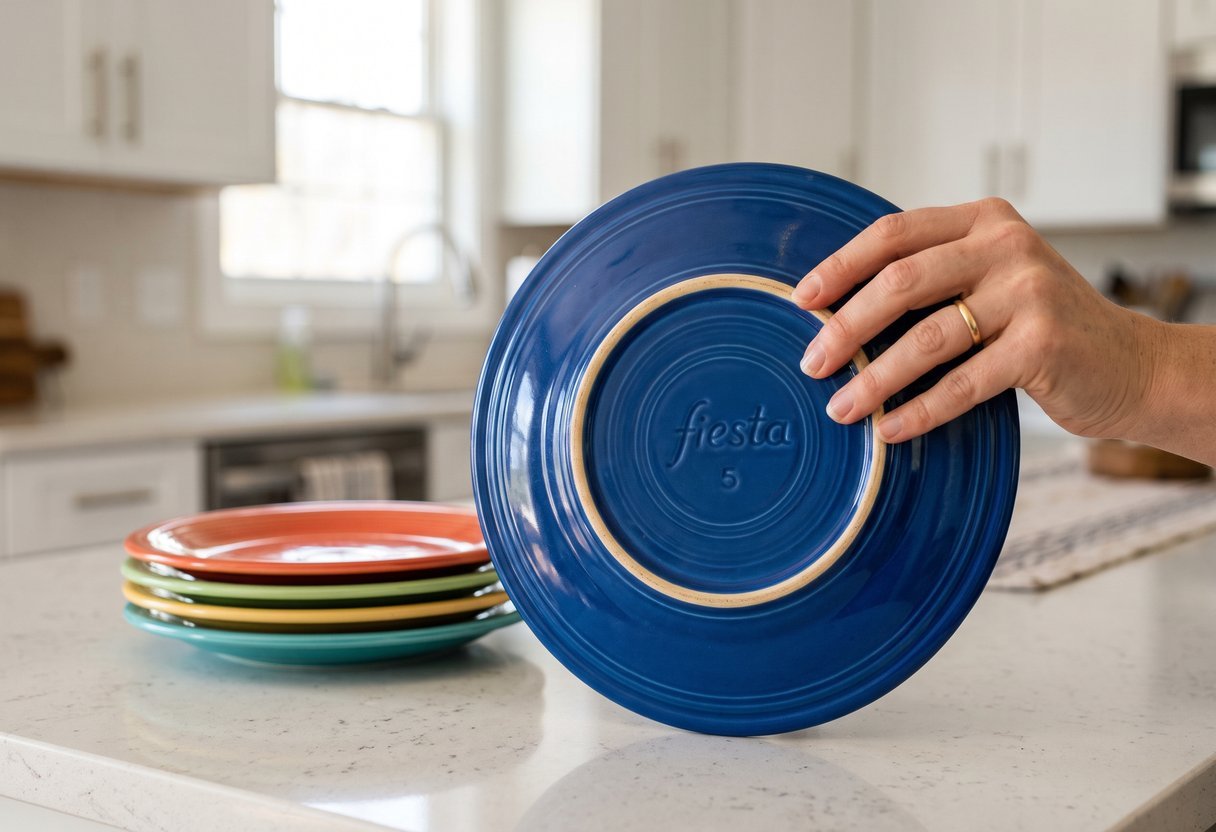
At a thrift store, 2 bright Fiesta plates sit side by side on a crowded shelf. Choosing by color alone can be misleading because the dinnerware has been produced in separate eras. An easy-to-miss detail can help narrow down which plate deserves a closer look.
Backstamps help separate vintage Fiesta from modern pieces
To identify vintage Fiesta dinnerware, check the underside for a lowercase “fiesta” backstamp, then compare the color with the original production dates. The lowercase mark identifies pieces from the 1936 to 1973 original run, while pieces made after the line’s 1986 revival use “FIESTA” in capital letters.
- Not bleach and not fabric softener, the way to get the sour smell out of kitchen towels that come out of the wash still stinking
- Onions and potatoes should never share a bin, and the sprouting is the clue
For a modern piece, a letter code can provide a more specific date: “AA” indicates 1986, “BB” indicates 1987, and “CC” indicates 1988. A rubber backstamp reading “HLC USA” and “genuine,” used mainly on cups and bowls since 1986, is another clue that a piece is modern. Because the Fiesta mark has changed many times, a backstamp is a starting point rather than a way to assign every piece an exact year.
Original colors narrow the production period
Homer Laughlin China Company introduced Fiesta in 1936 with designs by ceramicist Frederick Hurten Rhead. Its 5 original colors were Red, an orange-red; Blue, a cobalt shade; Green, a light green; Yellow, a deep golden shade; and Old Ivory, a yellowish cream. Color matters because each glaze had its own production period, but some periods overlap.
Cobalt Blue, Light Green, and Old Ivory were made from 1936 to 1951. Yellow ran from 1936 to 1969. A lowercase stamp on a Light Green piece therefore supports a vintage identification, but the color cannot establish whether that piece was made in 1936 or 1951. Modern colors can resemble older ones, so color alone is not enough.
Medium Green and early Red deserve a closer look
Medium Green was produced from 1959 to 1969 and is widely regarded as the rarest vintage Fiesta color. Its limited run and lack of a later revival help explain why collectors seek it out. It is distinct from the original Light Green, which ended production in 1951.
Vintage Red was made in 2 periods: 1936 to 1943 and 1959 to 1972. Production stopped during World War II after the U.S. government requisitioned uranium used in the orange-red glaze for atomic-bomb production. That interruption helps make prewar Red particularly prized, but a red color and lowercase stamp alone cannot distinguish a prewar piece from one made after production resumed.
Use matching clues before buying or serving food
Examine the backstamp and color together, then compare both with a collector reference for the specific piece. A lowercase mark can place it in the original era, while the color may narrow the range. If the mark is unclear or the color does not fit the expected dates, avoid assigning a precise age based on appearance alone.
The uranium oxide in vintage orange-red glaze also makes food use a separate decision from collecting. Treat vintage Red as display ware rather than everyday dinnerware, especially if its condition is uncertain, and keep fragile pieces away from children and pets. For meals, use dinnerware intended for regular food service; for a vintage find, record the mark and color before deciding what to buy.




Leave a Reply