

Your KitchenAid stand mixer still handles cookie dough, but you have no idea how many years it spent in someone else’s kitchen. If it came from a yard sale or a relative, how old is it really?
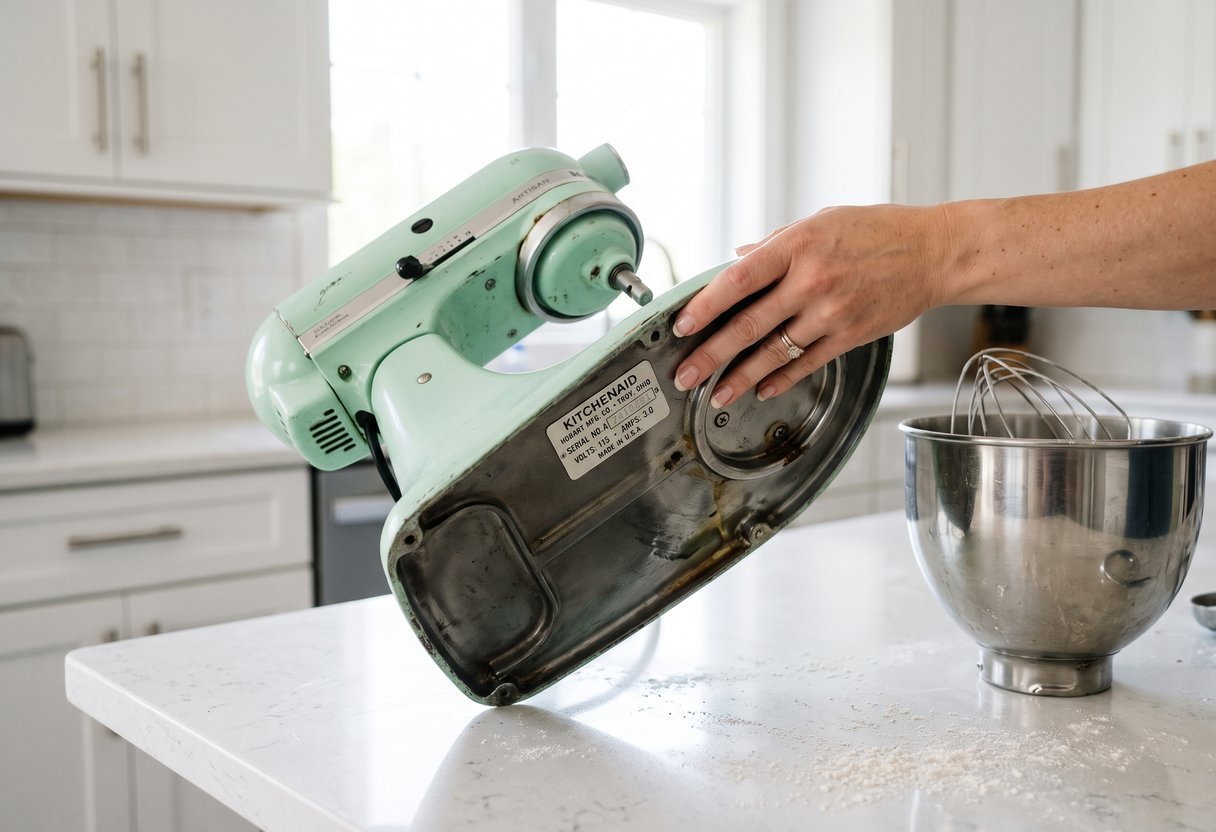
While wiping flour from a KitchenAid stand mixer after kneading bread, a homeowner notices scuffs that make it look decades old. Its color and shape offer little help in dating it, since familiar KitchenAid designs have lasted for generations. A small detail on the appliance offers a more reliable place to start, though it takes a different approach on older models.
The serial number contains the manufacturing date code
To find when a KitchenAid stand mixer was made, locate its serial number and read the date code within it. The code identifies the production year and week on most mixers made from the 1990s onward, or the production year and day on some older mixers. It is more useful for dating a machine than its appearance, since the basic mixer design has remained recognizable for decades.
- Before you microwave leftovers in a plastic tub, check for this label
- Your Ball jars carry a logo that dates them to the decade, and the blue ones are the ones to check first
On most stand mixers made from the 1990s onward, the serial number has 9 characters and begins with K. The 2nd character is a letter that indicates the manufacturing year, and the next 2 digits give the production week. The week narrows the date to a part of the year, but it does not identify an exact day.
Do not assign a year by guessing what the letter stands for. Keep the complete serial number and model number together when asking KitchenAid to confirm the year, particularly if the code does not match the usual 9-character format. KitchenAid appliance serial numbers with 9 or 10 characters may place the year code in the 2nd or 3rd position, followed by 2 digits for the production week.
Older mixers may use a 5-digit date code
Some KitchenAid stand mixers made before the 1990s have a separate 5-digit serial number under the base. In this format, the first 3 digits count the day of the year, starting with 001 for January 1, and the final 2 digits indicate the year. For example, 19087 indicates the 190th day of 1987, or July 9, 1987.
Unplug the mixer before looking underneath it, and set it on a stable surface rather than trying to read the base while it is running or plugged in. A heavy mixer can shift unexpectedly when tilted. If the number is worn, incomplete or in an unfamiliar format, avoid forcing it into either decoding method; use the model information and ask KitchenAid to help identify it.
The date helps put a mixer’s design in context
KitchenAid’s first stand mixer, the 5-quart Model H-5, debuted in 1919 and weighed 65 pounds. In 1937, designer Egmont Arens created the streamlined Model K, establishing a silhouette that continued on later mixers. KitchenAid stand mixers have been assembled in Greenville, Ohio, since 1946, and Whirlpool acquired the brand from Hobart in 1986.
Attachments offer one reason to distinguish a mixer’s age from its model. KitchenAid has maintained cross-generational attachment compatibility since the Model K, but the manufacturing date alone is not enough information for choosing a replacement part or arranging service. Check the model number along with the serial number before ordering.
A manufacturing date does not predict how long a mixer will last
Older KitchenAid mixers have a reputation for durability, but a date code does not show how a particular machine was used, maintained or repaired. Age alone cannot establish its condition or remaining service life. If an older mixer needs attention, record both numbers before seeking model-specific service guidance or parts.
Leave a Reply