

You open the flour canister to make pancakes and spot something unusual tucked among the flour. It looks out of place, but some families have kept it there for generations.
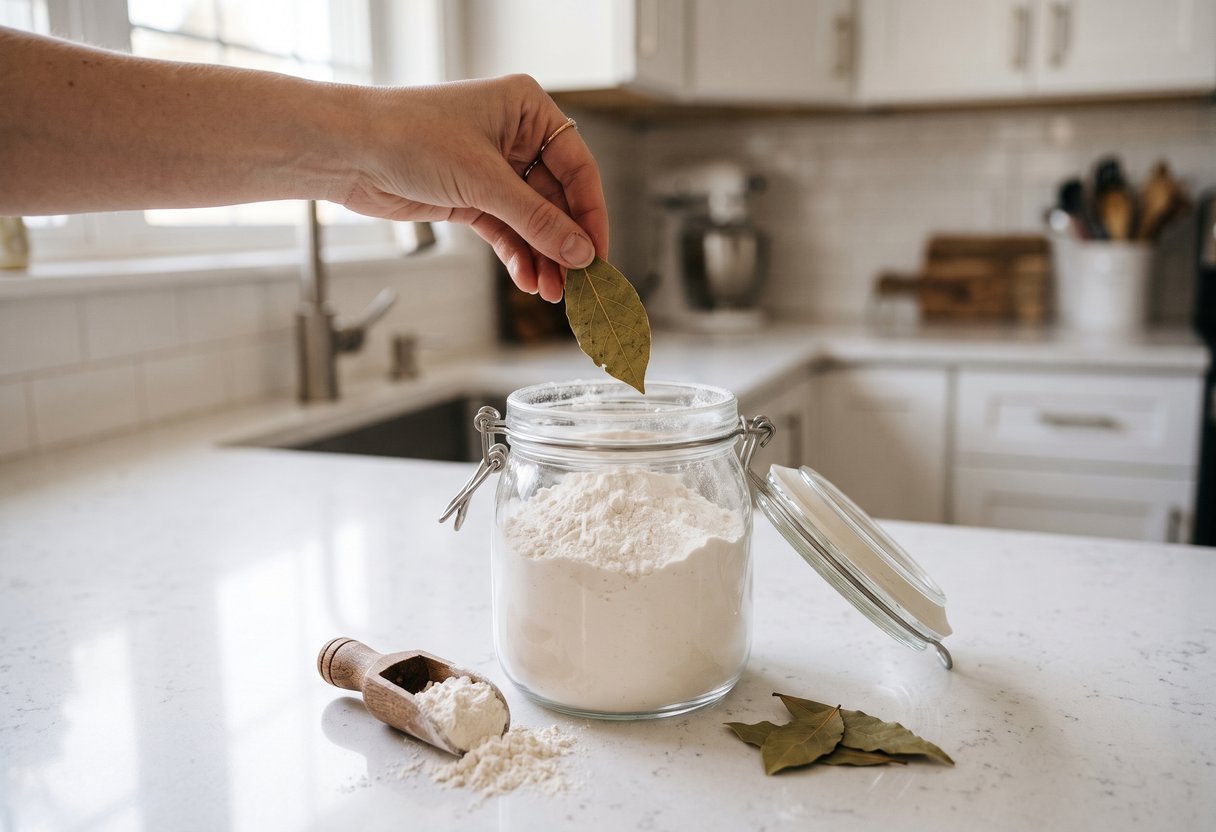
On the next shelf, the rice container holds the same unexpected addition. Tossing it out may seem like the obvious response, but that does not explain why it keeps turning up in dry goods. The reason is practical, though whether the habit works as intended is another question.
Bay leaves in flour are meant to deter pantry pests
Grandmothers put dried bay leaves in flour because the leaves’ strong scent was believed to keep weevils and other pantry insects away. The same practice extends to rice, pasta and cereal, but a bay leaf is not a proven way to protect any of these foods from infestation.
Flour beetles, weevils and pantry moths can turn up in stored dry goods. They may spread to nearby packages, and weevils can lay eggs inside food. That makes prevention more useful than trying to drive insects out of an open bag after they appear.
Bay leaves have shown effects in laboratory tests
Bay leaves contain eucalyptol, an aromatic compound often cited as the reason insects might avoid them. Their scent provides a plausible explanation for the household practice, but scent alone does not establish that a few dried leaves will protect flour on a pantry shelf.
In a 1986 laboratory study, bay leaves repelled adult red flour beetles placed in wheat flour. Researchers also found repellent effects from several isolated bay-leaf compounds, while another compound attracted the beetles. A 2018 laboratory study found that certain concentrations of separated bay-leaf oil compounds repelled red rust flour beetles.
Those tests examined particular insects under controlled conditions. They do not show that loose leaves in a home canister release enough of the right compounds, for long enough, to prevent an infestation.
Bay leaves are not reliable pantry protection
University of Minnesota Extension says there is no evidence that putting bay leaves in a cupboard prevents or eliminates stored-food pests. Utah State University Cooperative Extension likewise finds no scientific proof that the practice prevents insects in stored flour. A pest-free canister with a bay leaf in it may simply have been pest-free to begin with.
There is also no scientific evidence that bay leaves deter the common pantry moth specifically. A leaf will not seal a torn package or remove eggs already inside food. If a household chooses to keep leaves in a canister, they should be treated as an optional tradition, not the main defense; remove them before using the flour so they do not end up in the finished dish.
Sealed storage and freezing provide better protection
Transfer flour, rice, grains and other dry goods to tightly sealed glass, metal or heavy-plastic containers. A secure lid puts a physical barrier between the food and insects, unlike a scent that may weaken. Inspect packages for holes and check pantry shelves for signs of pests before putting new purchases away.
If dry goods may contain eggs or larvae, University of Minnesota and Purdue Extension advise freezing them at 0°F (-18°C) for at least 4 days before storage. Freezing addresses pests that may already be in the food; a sealed container helps keep new ones out afterward. Discard food with a visible infestation rather than relying on bay leaves to make it usable, then clean the shelf and check neighboring packages.
Leave a Reply