

That dusty box of canning jars in your pantry may deserve a second look before you send it to the thrift store. Some look nearly identical, but one small detail could change your plans.
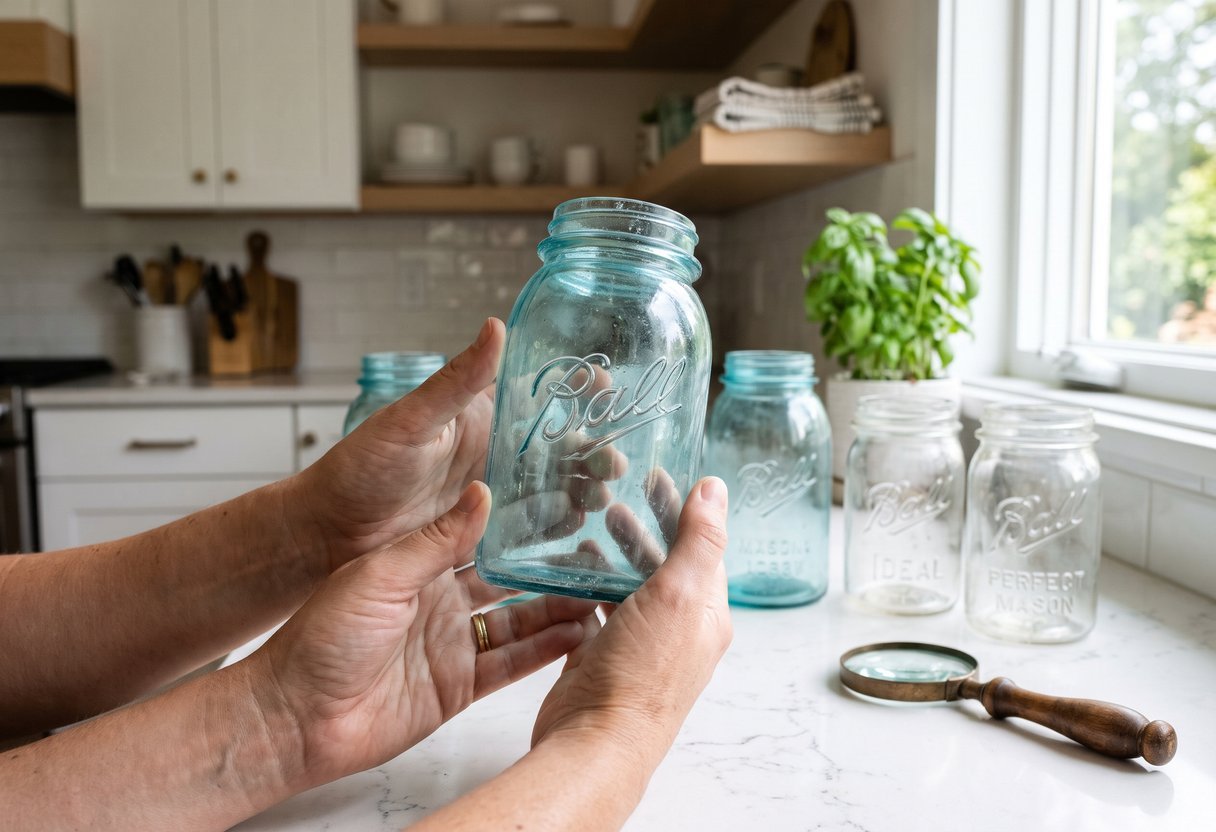
A blue Ball jar catches the light as cut flowers are trimmed at the kitchen counter. Its color might make it seem like a rare find, but many blue jars are common. Before using it as a vase, it is worth taking a closer look at a detail that is easy to miss.
The Ball logo and glass color provide the first clues
The embossed Ball logo identifies the maker and provides a starting point for dating a jar because its lettering changed over time. To estimate value, compare that date range with the glass color, size and condition rather than treating every blue jar as rare.
- A piece of chalk in the silverware drawer, what it’s for and why it keeps the forks from tarnishing
- The notch at the base of your chef’s knife has a name and a job most home cooks never use
Ball began making glass fruit jars in Buffalo, New York, in 1884. Their connection to home canning, durable glass and changing designs make the jars appealing to collectors. Age helps explain that appeal, but an old jar is not automatically a valuable one.
Changes in the logo narrow down a jar’s age
Start with the exact letters and the shape of the embossed logo, then compare them with a collector’s dating guide. These ranges are approximate, and neighboring styles can overlap:
- BBGMC: This mark is associated with Ball’s Buffalo jars, believed to date from 1884 to 1886.
- Triple L: A decorative loop on the cursive B resembles 3 L’s. This style dates to about 1896 to 1910.
- Underlined Ball: An underline beneath the script name, with PERFECT MASON in block letters below, points to about 1910 to 1923.
- Dropped-a Ball: This cursive style without an underline points to about 1923 to 1933.
- Later lettering: Another underlined version dates to about 1933 to 1962; simplified block-letter logos appeared after 1960.
Read the other embossed words as carefully as the logo. Most aqua jars marked BALL MASON, rather than BALL PERFECT MASON, date to about 1895 to 1913. Clear jars marked Ball Mason were also made in the 1960s and 1970s, so those words alone do not establish an early date.
Blue glass is common, but certain blue jars bring a premium
The soft aqua shade known as Ball Blue was standard for many Ball Perfect Mason jars from around 1910 through the 1930s. Its color resulted in a recognizable look, not automatic rarity. A typical aqua jar should not be priced as an unusual cobalt-blue example.
Blue Perfect Mason jars from the 1910s and 1920s can sell for more than clear jars of the same era. An excellent-condition half-gallon blue example may bring more still. Common vintage jars, particularly clear jars from later production runs, typically sell for about $10 to $30, while early logos and rarer colors can bring substantially more.
Condition and reproductions limit what the clues can prove
Wear can obscure lettering, and reproductions make color alone an unreliable test of age. Even a genuine early logo may appear on a jar whose size and color were widely produced. Check the full inscription against an identification guide, and ask an antique specialist to examine a costly jar before buying it.
Under good lighting, inspect the rim and body as well as the embossing. Avoid abrasive cleaning or harsh chemicals that could affect aged glass, and handle chipped or cracked jars carefully. Do not assume a collectible jar is suitable for home canning; choose a sound jar intended for canning and follow current tested instructions instead.
A careful comparison is more useful than a color label
Before paying a collectible price, record the logo, other wording, color, size and condition, then compare similar examples with an identification guide or antique specialist. That combination gives a firmer basis for judging the jar than “Ball Blue” on a seller’s tag.
Leave a Reply