

While chopping onions for dinner, you might spot a tiny cutout near your chef’s knife handle. It looks like a minor design quirk, but there’s more to it than most home cooks realize.
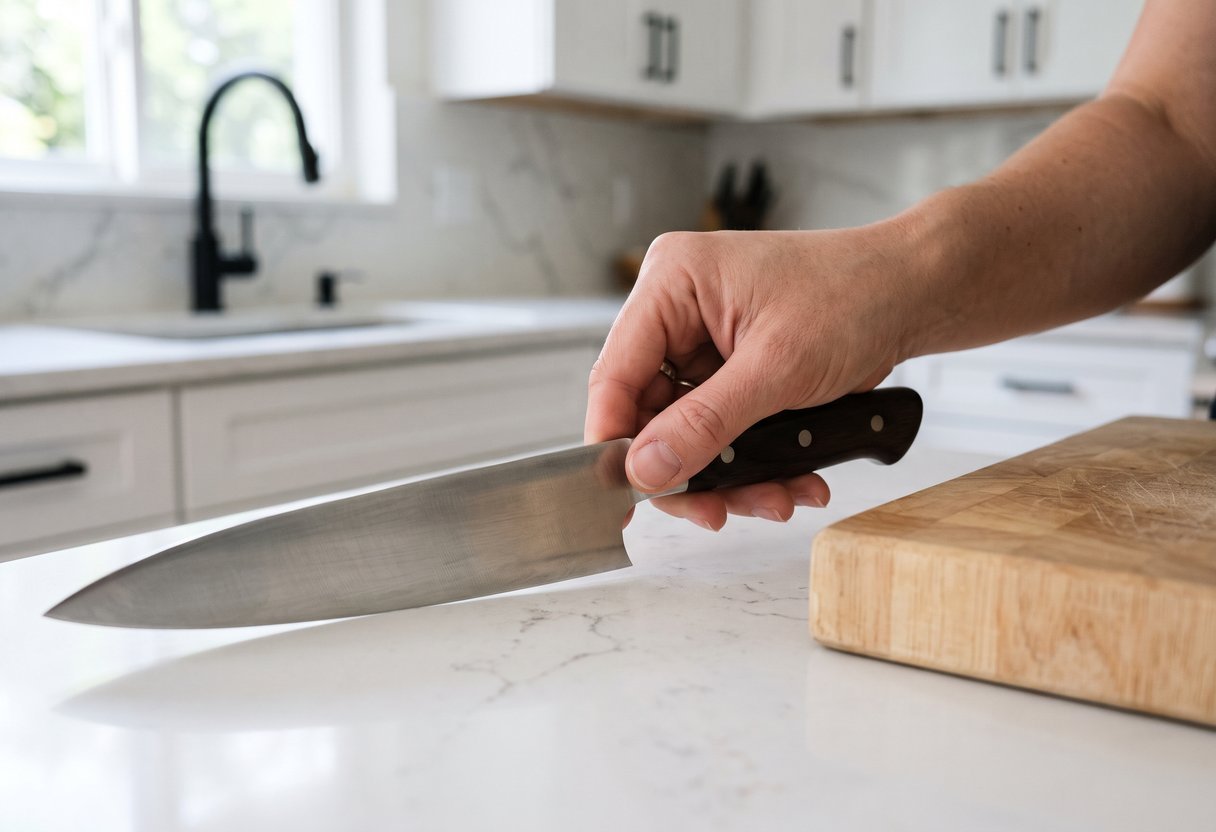
Carrot slices come out uneven, even though the chef’s knife is sharp. Gripping the handle more tightly may seem like the fix, but extra pressure does not necessarily make the blade easier to control. A small detail at the base of the blade is worth a closer look, though not every chef’s knife has one.
The notch at the base of the blade is a choil
The small notch where a chef’s knife’s cutting edge ends near the handle is called a choil. Its original purpose was to mark where sharpening should stop, so the sharp edge has a defined endpoint. The notch sits at the transition between the cutting edge and the ricasso, the flat, unsharpened portion of a blade near the handle.
Not every chef’s knife has a visible choil. Some blades run into the handle or bolster without a separate notch, so there may be nothing to identify or use as a sharpening stop. The shape of the knife matters more than the name when deciding where to place a hand or sharpening tool.
A choil can mark the edge and support a grip
During sharpening, a small choil gives the cook a visible place to end each pass along the cutting edge. That helps distinguish the edge that needs sharpening from the unsharpened metal near the handle. The notch does not set a sharpening angle or make an uneven edge straight; those still depend on the tool and technique.
Choils also differ in size. A small sharpening choil is not meant to hold a finger, while a larger finger choil may provide room to grip closer to the blade. Depending on the knife’s shape, the choil area can offer a point of contact for a finger and help keep the hand from moving toward the edge, but it is not a substitute for a secure grip.
Many home cooks do not need to use the choil
Many home cooks wrap the whole hand around a chef’s knife handle. That grip does not bring the fingers against the choil area, so any possible benefit as a finger rest goes unused. It does not prevent the cook from using a sharpening choil as an endpoint when maintaining the edge.
Some cooks use a pinch grip instead, holding the blade between the thumb and index finger while the remaining fingers hold the handle. A finger may rest near the choil for stability, depending on the knife and the person’s hand. The notch itself does not have to be large enough to fit a finger for a cook to grip the blade near it.
The notch is not a required feature
A knife without a separate choil can still be held with a pinch grip if its shape allows a comfortable, secure hold. Likewise, a cook who prefers a full-handle grip gains little from a finger choil during cutting. There is no reason to force a fingertip into a small sharpening notch or place it against the cutting edge.
A choil also cannot correct poor sharpening control. If the edge near the handle is difficult to reach because of the knife’s shape, follow the sharpening tool’s instructions or have the knife sharpened by a professional rather than making extra passes into the handle area.
A comfortable grip matters more than a notch
To try a pinch grip, set a cutting board on a stable surface, then place the thumb and index finger on opposite sides of the blade just ahead of the handle. Wrap the remaining fingers around the handle and check that none touch the cutting edge before cutting. If the grip feels unstable, return to a secure handle grip.
When choosing a knife, check whether the edge ends in a defined notch and whether the area near the handle feels comfortable to hold. Keep fingers clear of the sharp edge regardless of the design, and use the choil as a sharpening guide only when the knife actually has one.
Leave a Reply