

Clearing out Grandma’s china cabinet can leave you staring at shelves of white glassware and a growing donation box. Before you pack everything away, one overlooked detail might make you pause.
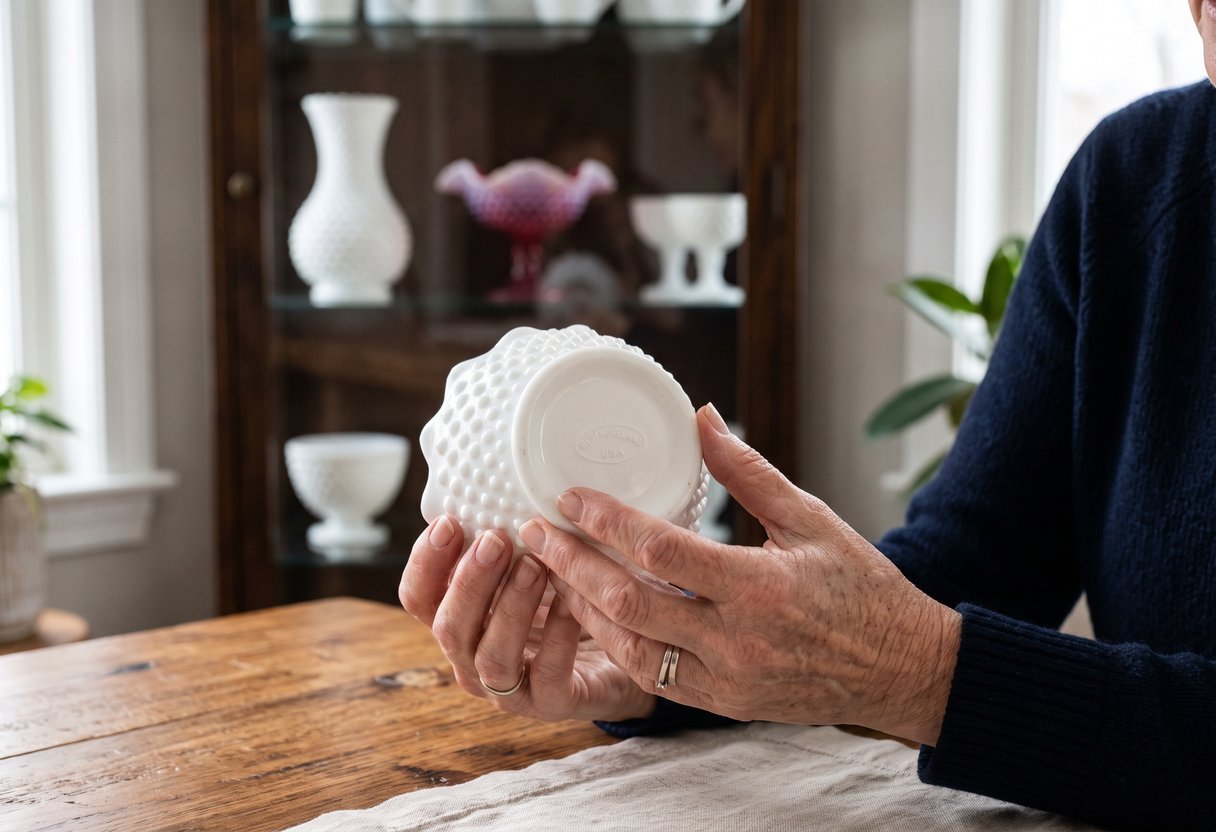
A white glass vase is halfway into a paper bag when its textured surface catches the light. Similar-looking pieces are easy to group together, but a quick glance cannot reveal differences in their history or value. A closer look before the bag goes out may be worth a few minutes.
Some Fenton hobnail milk glass is worth a closer look
Your grandmother’s hobnail milk glass might be worth more than expected if it is a rare Fenton color or a complete set, rather than a common white piece. Checking its color, form, marks, and condition before donating helps distinguish potentially valuable items from the many white pieces that typically sell for about $8 to $50. Age alone does not make milk glass valuable.
- Neither Dawn nor vinegar, the way to get the orange stains out of plastic containers after spaghetti sauce
- Does the “sanitize” cycle on your dishwasher do anything, or is it just a longer wash
Brothers Frank L. Fenton and John W. Fenton founded the Fenton Art Glass Company in Martins Ferry, Ohio, in 1905; the company later moved to Williamstown, West Virginia. Fenton introduced its milk glass Hobnail line in 1939-1940, and the pattern became its top-selling line. Traditional glass production at the Williamstown factory ceased in July 2011.
Marks and evenly spaced hobs help identify Fenton glass
Fenton glass made before 1970 was typically unmarked, so the absence of a name does not rule out an older piece. Look at the raised bumps, called hobs: genuine Fenton examples generally have round, uniform hobs arranged in an even pattern. Color, shape, and overall craftsmanship matter too, because other makers also produced hobnail glass.
Starting in 1970, Fenton molded a raised oval logo with its name in script into the base of its glass. Beginning in 1980, a number beneath the logo indicated the decade, such as “8” for the 1980s. Fenton also used paper labels during parts of 1957 to 1985, but labels can be missing from otherwise genuine pieces.
Color and completeness can raise the price
Common white Fenton hobnail pieces in good condition are generally the least valuable, often selling for roughly $8 to $50. Colored examples can bring more than comparable white pieces: cranberry opalescent hobnail often falls around $60 to $200 or more. Rare epergnes can reach about $250 to $700.
Form and completeness also affect value. A Fenton Hobnail punch bowl set with its pedestal, ladle, and cups can sell for roughly $150 to $600, while individual pieces from a set typically bring about $50 to $150. Those ranges are not a guarantee for a particular piece; condition and the presence of matching parts matter.
A Fenton logo is not proof by itself
Reproductions have appeared in antique shops and online listings, and some non-Fenton glass has been given a counterfeit oval Fenton mark. Compare a suspected piece’s logo and decade number with Fenton’s marking timeline, then inspect the hob spacing and craftsmanship. An uneven pattern is a reason to investigate, not enough evidence on its own to declare a piece fake.
If the maker remains uncertain, avoid pricing the piece solely by its label or an asking price seen online. A reputable antique-glass appraiser can assess an unusual color or form before it is sold as Fenton.
Set aside promising pieces before donating
Check inherited hobnail glass for unusual color, a complete set, or a less common form before packing it for donation. Keep the pieces together so matching parts are not separated, and handle chipped glass carefully. If identification is uncertain, have the promising pieces evaluated before deciding what to keep, sell, or donate.




Leave a Reply