

After roasting dinner, your baking sheet still has brown patches that refuse to budge with ordinary washing. Before you give up on it, take another look at what you already have at home.
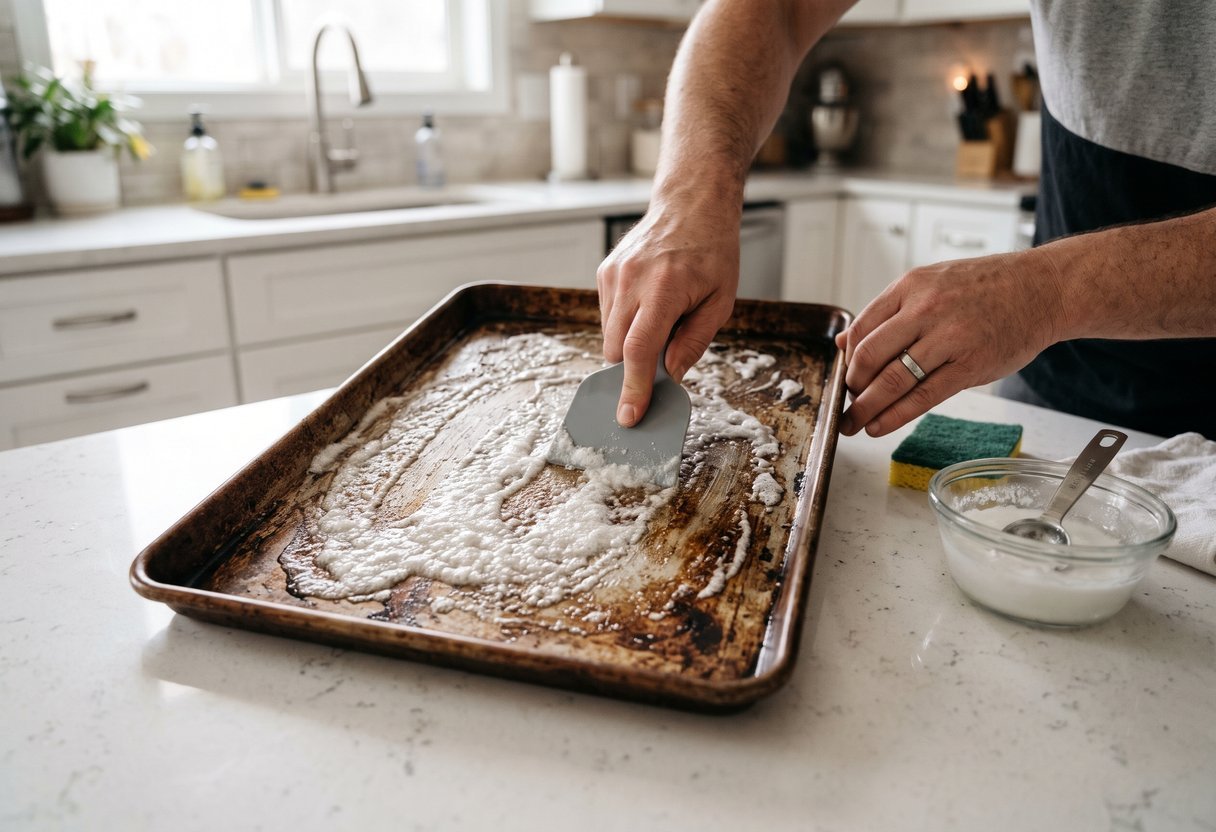
A baking sheet pulled out for a fresh batch of cookies still has a brown ring around the rim. Dish soap removes loose grease, but a quick wash often leaves baked-on residue behind. Scrubbing harder can damage the surface, especially if the sheet has a nonstick coating. A gentler approach may help, but the sheet’s finish matters.
Baking soda and hydrogen peroxide can lift brown stains
A paste of baking soda and hydrogen peroxide can loosen stubborn brown stains on uncoated baking sheets. It works best as a deep clean for baked-on grease and food residue that ordinary dishwashing has not removed.
Repeated heat can leave thin layers of grease and food stuck to a sheet pan. Those layers may remain brown even after the pan has been washed. Staining does not necessarily mean the sheet is dirty, but a paste can help remove residue that still clings to the surface.
The 2 ingredients work in different ways
Baking soda is mildly abrasive and alkaline, so it helps loosen residue without the aggressive scraping of steel wool. Hydrogen peroxide acts through oxidation, helping break down the stains and grime holding that residue in place. Time on the pan gives the paste a chance to soften the buildup before scrubbing.
The mixture may bubble as oxygen is released. Bubbling is expected, but it does not mean every dark mark will disappear. Heavy, set-in stains may need more than 1 cleaning, while marks that remain after the residue is gone may be discoloration rather than something to scrub off.
The paste needs time before scrubbing
Pour 1/4 to 1/2 cup (60 to 120 mL) of baking soda into a bowl. Slowly stir in 2 to 3 tablespoons (30 to 45 mL) of hydrogen peroxide until the mixture is thick, like toothpaste. Add the liquid gradually so the paste stays in place when spread on the pan.
Spread the paste over the stained areas, or across the whole baking surface if needed. Let it sit for 30 minutes; for heavy buildup, leave it for several hours, up to 9 hours. Scrape away the dried paste with a plastic scraper, then scrub with a sponge and warm, soapy water. Rinse thoroughly and dry the sheet completely.
Coatings and cleaning chemicals require caution
Skip this abrasive paste on nonstick-coated sheets, where scrubbing can damage the coating. Wash those pans with a nonabrasive sponge and follow the manufacturer’s care instructions instead. Avoid steel wool on any baking sheet: it can scratch metal surfaces and permanently damage nonstick coatings.
Do not add vinegar to the baking soda and peroxide paste, and do not mix it with other cleaners. Never mix bleach with vinegar or ammonia. Keep cleaning ingredients and a coated pan out of reach of children and pets while the paste sits. Oven cleaner is not a substitute for this method because it can etch or discolor baking sheets and damage nonstick coatings.
Routine washing helps prevent new buildup
Parchment paper or a silicone baking mat can keep food and grease from contacting the sheet directly. Once the pan is cool enough to touch, wash away residue rather than leaving it to sit. Prompt washing is the simpler choice for everyday messes; save the paste and its longer wait for stubborn, baked-on stains.
Leave a Reply