

You pull a Le Creuset pot from the cabinet and spot a small number inside its lid. It seems easy to overlook, until you’re comparing pots at the store or hunting for a replacement.
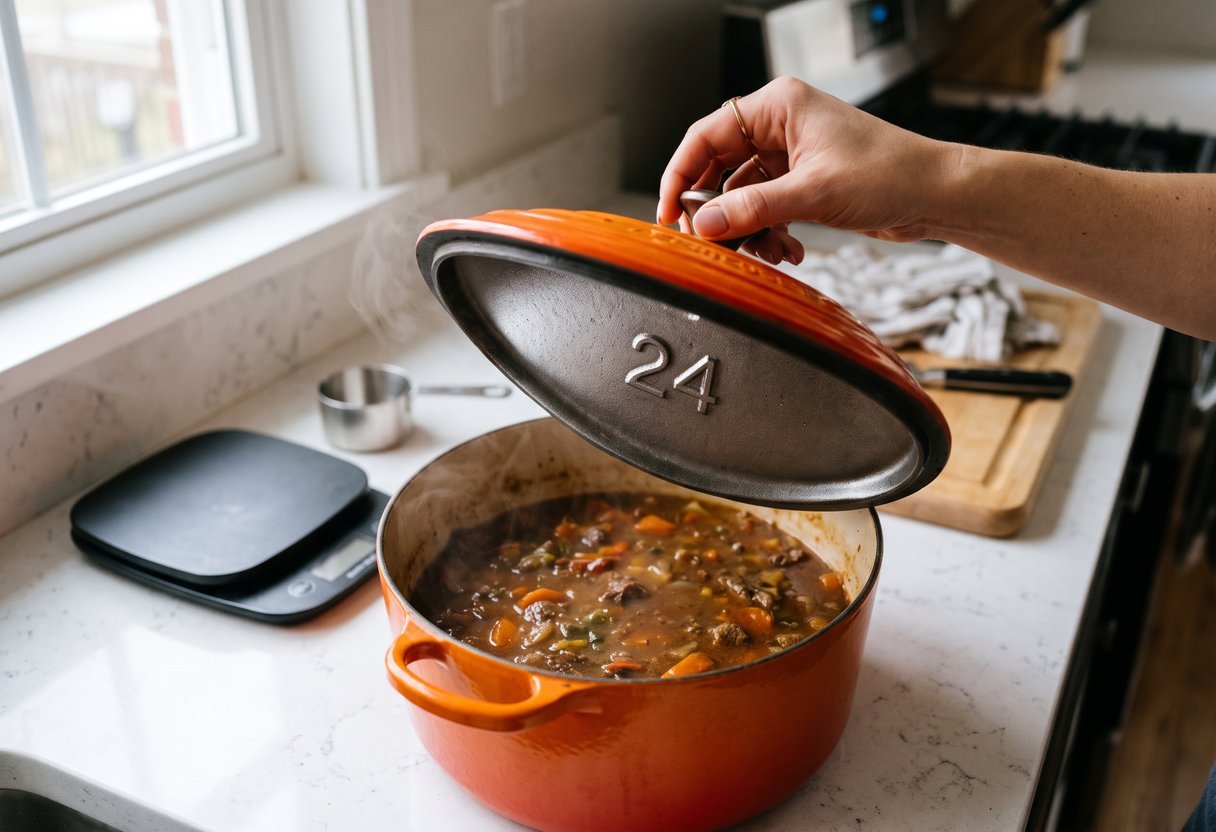
At the cookware store, 2 Le Creuset Dutch ovens in the same color carry noticeably different price tags. Comparing the finish does little to explain the gap, and guessing by weight is imprecise. A small detail on the cookware offers a more useful clue, though it is easy to miss.
The number on the lid identifies the cookware’s size
The number molded into a Le Creuset lid gives the cookware’s size in centimeters, not a model or batch number. It helps identify the pot and find a corresponding lid. On a round Dutch oven, it refers to the diameter without handles; on an oval Dutch oven, it refers to the longest dimension.
The pot base may carry the same number. On skillets, braisers, sauciers and grills, the number indicates the cooking-surface width instead. That distinction matters when comparing shapes: a “24” on a round pot and a “24” on an oval pot do not describe the same measurement.
A size number helps estimate capacity
A round Dutch oven marked “24” measures about 9.4 inches (24 cm) across and holds approximately 4.2 to 4.5 quarts. It is a practical size for meals serving roughly 4 to 5 people. The number describes width, however, not volume; capacity must be checked separately when a recipe calls for a particular pot size.
Common round Dutch oven numbers run from 16 through 34. A smaller “16,” about 6.3 inches (16 cm) across, holds roughly 1.4 quarts (1.3 liters) and suits smaller portions. A “30,” about 11.8 inches (30 cm) across, holds roughly 8.9 quarts (8.4 liters), leaving more room for a roast or batch cooking.
A matching number does not always guarantee a fitting lid
Older Le Creuset cookware may use letters rather than numbers: A corresponds to 6.3 inches (16 cm), for example, while H corresponds to 11.8 inches (30 cm). Designs changed over time, so a modern lid and an older pot may not fit properly even when their marked sizes correspond. Check the cookware’s shape and production era, then test the lid on the cool pot before buying a replacement.
A lid should sit as intended without being forced into place. If the number matches but the fit does not, look for a lid from the same series or era rather than relying on the size mark alone. Keep children away while checking a lid on cookware that has recently been used; let both pieces cool first.
Size affects price within the same cookware line
Le Creuset’s Signature Round Dutch Oven is listed from $285 to $680 across its size range. Larger pots use more enameled cast iron, and prices rise with size within that line. The lid number is useful when comparing those pots, but it is not a price code: shape, material line and finish also matter when comparing different pieces.
Older details can affect oven use
Le Creuset began making enameled cast-iron cookware in 1925, when Armand Desaegher and Octave Aubecq established a foundry in Fresnoy-le-Grand, France. Vintage lids may have loop handles, while later lids use knobs. Those differences matter when identifying an older lid, but its size mark remains the starting point for a fit check.
Check the knob before putting a lid in the oven. Earlier classic phenolic knobs are rated to 375°F (190°C), while the phenolic knobs introduced with the Signature line in 2010 are rated to 480°F (248°C). If the knob type is uncertain, identify it before oven use rather than assuming the higher rating applies.
Leave a Reply