

Thanksgiving is approaching, and the turkey in your freezer still feels like a solid block. Getting it ready for the oven may take longer than you expect, leaving less room for last-minute decisions.
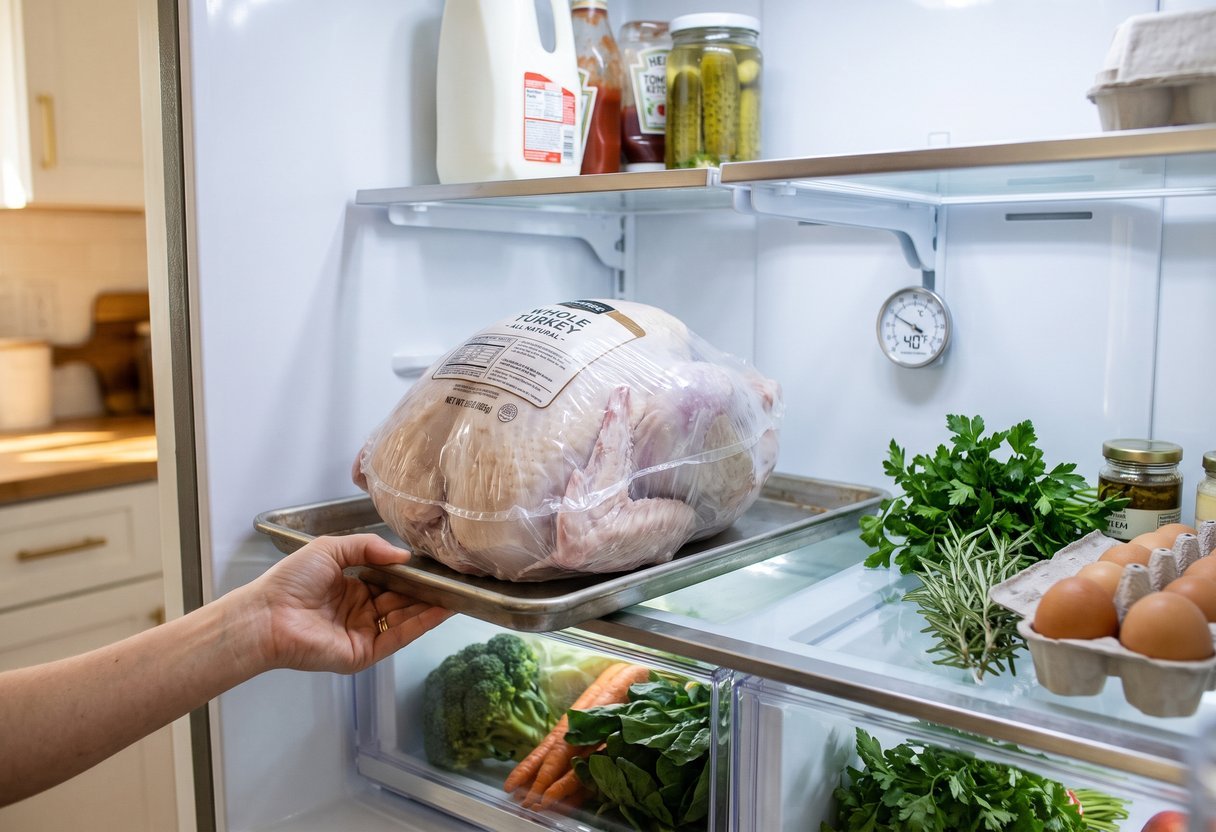
At the grocery store, a 20-pound turkey lands in the cart with Thanksgiving less than 2 weeks away. Allowing the same thawing time as for a smaller bird could leave its center icy on cooking day. Setting it out to speed things up is not a safe fallback. A quick check before putting groceries away can help avoid both problems.
Counter thawing lets the outside of a turkey warm too quickly
A whole turkey should thaw in a refrigerator set at 40°F (4°C) or below, not on the kitchen counter. At room temperature, its outer layers can enter the 40°F to 140°F (4°C to 60°C) “Danger Zone,” where bacteria multiply rapidly, while the center remains frozen.
- Not bleach and not a magic eraser, the way to get a stubborn stain out of a laminate countertop
- Your box grater has four sides, and the one nobody touches is for something specific
That frozen center can make a turkey feel cold even when its surface is no longer at a safe temperature. Setting it out overnight is not a shortcut for a slow thaw. If a turkey has sat at room temperature for more than 2 hours, discard it rather than cooking or refreezing it.
Refrigerator thawing takes about 1 day per 4 pounds
The USDA Food Safety and Inspection Service (FSIS) advises allowing approximately 24 hours for every 4 to 5 pounds of turkey in a refrigerator at 40°F (4°C) or below. Using 1 day per 4 pounds when planning gives the turkey time to thaw without relying on a last-minute counter thaw.
The refrigerator thawing chart puts a 4- to 12-pound turkey at 1 to 3 days, a 12- to 16-pound turkey at 3 to 4 days, a 16- to 20-pound turkey at 4 to 5 days, and a 20- to 24-pound turkey at 5 to 6 days. A 15-pound turkey, for example, takes about 3 days. Once fully thawed in the refrigerator, it can stay there for another 1 to 2 days before cooking.
Keep the turkey in its original wrapper on a tray or in a container. That catches juices before they can drip onto other food. If the refrigerator is above 40°F (4°C), its thawing schedule is not a safe guide; use a refrigerator that stays at or below that temperature.
Cold water can thaw a turkey faster with close attention
Cold-water thawing takes approximately 30 minutes per pound. Keep the turkey in a leak-proof wrapper, submerge it in cold water, and change the water every 30 minutes so it stays cold. The wrapper also keeps thawing water from contacting the turkey.
At that rate, a 16- to 20-pound turkey takes about 8 to 10 hours, while a 20- to 24-pound turkey takes about 10 to 12 hours. Cook it immediately after thawing by this method. If regular water changes are not practical, plan for refrigerator thawing instead; hot water is not a safe way to speed the process.
Planning backward avoids an unsafe shortcut
Start with the cooking day, check the turkey’s weight, and count backward using the refrigerator timetable. A turkey that needs more time can remain frozen until thawing can be done safely. The key is to keep its outer layers cold throughout the thaw, not just to find a frozen spot in the center.
Leave a Reply