

You unload the dishwasher, but your glasses still look cloudy and the machine smells less than fresh. Some homeowners are adding something unexpected before the next cycle, and it has nothing to do with detergent.
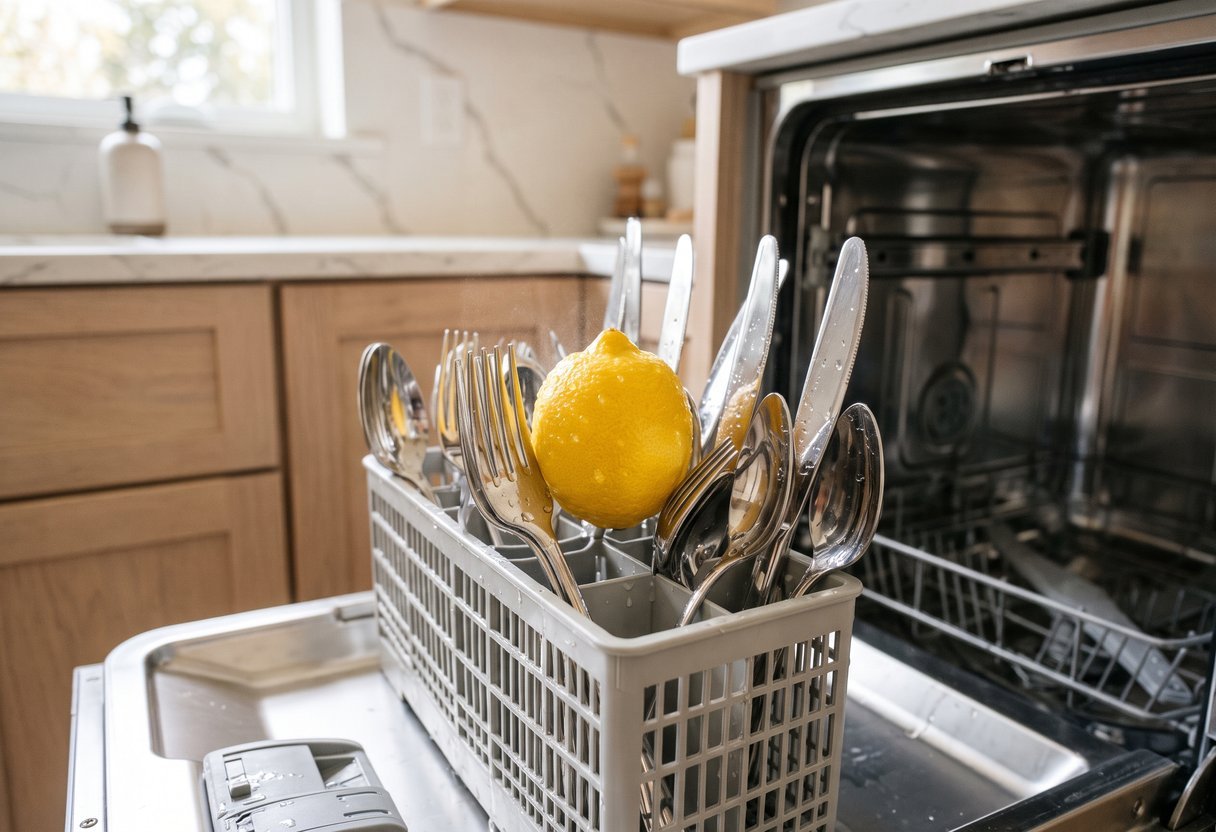
While loading forks after dinner, someone notices a lemon half tucked into the cutlery basket. Adding more detergent may seem like the way to improve the next wash, but extra soap cannot solve every dishwasher problem. There is a reason the fruit is there, though it has its limits.
A lemon half can help with light hard-water residue
People put a lemon half in the dishwasher’s cutlery basket to help loosen hard-water deposits and leave a faint, fresh scent. The lemon contains citric acid, which can act on the minerals behind cloudy film and spots on dishes. It is a popular home cleaning trick, not a substitute for detergent or a proven way to descale a heavily coated dishwasher.
- Diners have kept rice in the salt shaker for decades, and the reason still works at home
- Seven things in your kitchen that hydrogen peroxide cleans better than bleach
Hard water leaves calcium and magnesium deposits known as limescale. Over time, those deposits can collect inside the machine and show up as spots on glasses. Food residue and trapped moisture can also contribute to odors, though a lemon scent alone does not mean the dishwasher is clean.
Citric acid helps loosen mineral deposits
Citric acid binds to calcium and magnesium ions, making it harder for them to form deposits and helping loosen existing limescale. Because lemon juice is acidic, it can also react with alkaline limescale and soap residue so the wash water can carry some of that buildup away. The lemon’s acidity may help cut grease, while its natural oils leave a mild scent.
The amount of juice a lemon releases during a cycle can vary. A lemon half may help with occasional spots or odors, but its effect should not be treated as equivalent to a measured dose of dishwasher descaler or rinse aid.
A seeded lemon half goes in the cutlery basket
Cut 1 lemon in half and remove all visible seeds. Place 1 half cut side down in the cutlery basket, or secure it on the top rack so it cannot fall onto moving parts. Add the usual dishwasher detergent, load the dishes and run a normal cycle. Remove the spent lemon afterward.
Check the filter after the cycle, especially if the lemon was soft or already squeezed. Seeds can clog the filter or get caught elsewhere in the machine, and bits of pulp may escape the basket. If pulp is collecting in the filter, stop using lemon halves and clean the filter as directed in the dishwasher manual.
Heavy limescale needs a more thorough approach
A lemon half is better suited to light buildup than thick mineral deposits. For a deeper descale, about 2 teaspoons of store-bought citric acid powder can be used in an empty hot cycle, provided the dishwasher’s instructions allow it. This type of cleaning is commonly done 3 to 4 times a year, with more attention needed where water is especially hard.
Another option is to squeeze and strain a lemon, then place its juice in a dishwasher-safe bowl on the top rack. Keep citric acid powder and cleaning products away from children and pets. Never mix acidic cleaners, including lemon juice or vinegar, with bleach; bleach must not be mixed with ammonia either.
The filter and dishwasher instructions still matter
Neither a lemon half nor lemon juice replaces regular filter cleaning, and dishwasher manufacturers have not broadly endorsed the lemon-half trick. If spots persist after cleaning, follow the appliance manual’s guidance for hard water and dishwasher cleaners rather than adding more fruit to each load. For an occasional mild odor or light film, a seedless lemon half is a simple option, followed by a filter check when the cycle ends.
Leave a Reply