

Turn over an old cast iron skillet at a yard sale, and you might spot a number stamped underneath. It looks straightforward, but that little marking can leave even experienced home cooks guessing.
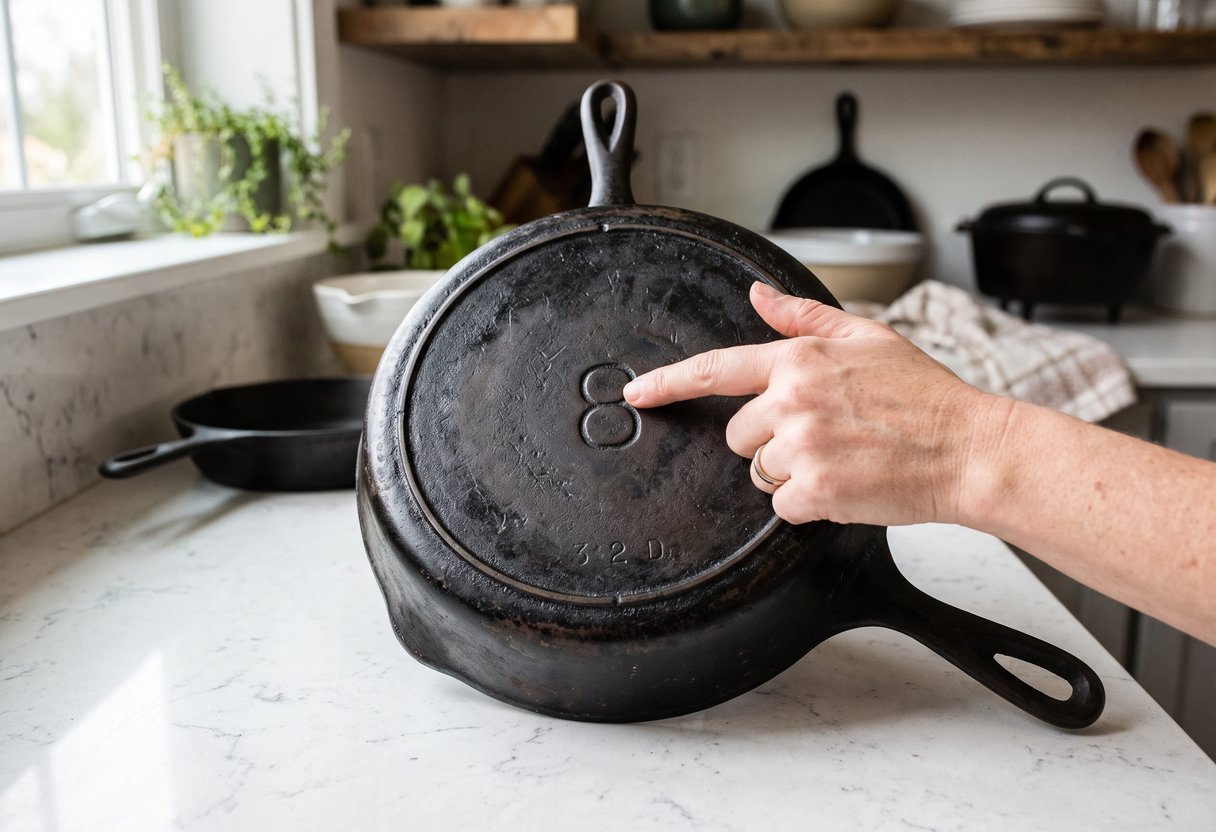
On the kitchen counter, a tape measure stretched across the skillet’s rim gives a measurement that does not match the stamped number. Measuring again may not help, since skillets from different makers can carry the same number but have different dimensions. The mismatch does not mean the pan was marked incorrectly. It points to an older convention that a tape measure alone cannot explain.
The number on a vintage skillet is a stove-eye size code
The number cast into the bottom or handle of a vintage cast iron skillet identifies a size originally meant to fit a circular opening, called an eye, on a wood-burning cookstove. It is there to identify which stove opening the skillet was made for, not to give the pan’s diameter in inches. A No. 8 skillet, for example, is not necessarily 8 inches across.
That distinction matters when choosing a pan for a stove or replacing one in a set. The number is a useful starting point, but it cannot tell a buyer how much cooking surface the skillet provides.
Stove-eye sizing continued after wood stoves
Cast iron skillets were made to sit over round openings in wood-burning cookstoves. Matching the skillet to the opening helped position the pan over the heat. As gas and electric ranges replaced wood stoves, manufacturers continued using the familiar size numbers even though the original openings were no longer part of most kitchens.
Vintage skillet numbers commonly run from about No. 2 or No. 3 through No. 14, with a rare No. 20. These are size designations, not a sequence of inch measurements. A 1924 Wagner catalog, for instance, listed the bottom diameter of its No. 7 regular skillet as 8 1/4 inches (21 cm).
Griswold and Wagner used additional numbers
The size code was not identical across foundries. A Griswold No. 3 or No. 4 ran somewhat smaller than the corresponding Wagner size, and a Martin No. 3 was the same size as a Wagner No. 2. Two pans with the same cast size number therefore may not have the same cooking surface.
Other markings can identify a product or casting pattern rather than a second size. Griswold used separate pattern numbers: its No. 6 skillet carries “699,” while its No. 8 carries “704.” Wagner began using 4-digit catalog numbers in 1924; “1058” identifies a regular No. 8 skillet, while “1056” identifies a regular No. 6. A letter after a marking, such as the “C” in “1053C,” identifies a specific foundry mold or pattern, not another skillet size.
Modern markings need a different reading
Around the 1950s, some manufacturers began adding dimensional labels such as “10 5/8 IN.” or “6-1/2 Inch Skillet.” Those labels state an inch-based dimension and should not be read the same way as an older stove-eye number. Checking which kind of marking appears on a pan prevents a misleading size comparison.
The traditional system has not disappeared. On Lodge’s L10SK3 skillet, the “10” refers to the old No. 10 stove-eye size, although that pan measures 12 inches (30 cm) across the top. A modern No. 8 can measure about 10 1/4 inches (26 cm) across the top rim.
Actual measurements matter more than matching numbers
For a working skillet, measure across the top rim to check whether it will fit a burner or storage space, and measure the cooking surface if usable area matters. Compare the same part of each pan: a bottom-diameter figure from an old catalog is not a top-rim measurement. Handle hot cast iron with a protective mitt, and let it cool before measuring or turning it over to read its markings.
For a vintage purchase, the size, pattern number, maker’s mark and any letter can help identify a skillet, but a number alone cannot establish its exact age or value. When matching pans, ask for actual rim and cooking-surface measurements rather than relying on two No. 8 markings to mean the same dimensions.
Leave a Reply